Executive Summary: What Is Major Menus in 2026?
Major Menus (majormenus.com) is a corporate lunch delivery platform founded in 2007 by Louisiana native Sean Donovan. Unlike third-party gig apps like DoorDash or Uber Eats that send independent drivers for single orders, Major Menus aggregates office orders to provide free pooled delivery from a rotating “Restaurant of the Day” directly to company breakrooms.
- Cost to Employer: 100% free with zero setup fees, zero monthly software dues, and zero binding contracts.
- Menu Pricing: 98% of partner restaurants maintain standard in-store counter pricing (rare vendor markups capped at 10%).
- Lead Time: Individual daily lunches require orders by roughly 10:00 AM (2 to 2.5 hours prior to delivery); meeting catering requires as little as 2.5 hours notice.
- Primary Markets: Baton Rouge, New Orleans, Metairie, Lafayette, Denham Springs, and Nashville, TN.
- Core Services: Restaurant of the Day (individual ordering), Feed My Meeting (executive group catering), and Meal Subsidy Programs (employer-funded meal stipends).
Anyone who has managed an office during the lunch rush knows the familiar chaos: five different couriers wandering the lobby looking for badge access, cold orders sitting unclaimed on reception counters, and employees losing twenty minutes comparing delivery fees across multiple smartphone apps. In an era where workplace perks matter more than ever, disorganized food delivery creates unnecessary friction.
Operating quietly across Louisiana and Tennessee since 2007, Major Menus has processed over 2.5 million corporate lunch orders totaling more than $28 million in volume. Yet many human resources directors and office coordinators still wonder how the business model functions, whether hidden markups exist, and how it compares to nationwide aggregators like EZCater or DoorDash for Work. This definitive operational review examines the pricing mechanics, ordering rules, logistical safety nets, and budgeting calculations behind the platform in 2026.
In This Guide
- 1. How Major Menus Works
- 2. The 2026 Pricing & Fee Truth
- 3. Three Core Services Dissected
- 4. Feed My Meeting Catering
- 5. Meal Subsidy & Allowance Plans
- 6. Office Budget & Savings Calculator
- 7. Major Menus vs EZCater vs DoorDash
- 8. Cities & Supported Markets
- 9. Logistics, Refunds & Late Deliveries
- 10. Office Manager Implementation Playbook
- 11. Frequently Asked Questions
- 12. Final Verdict & Key Takeaways
1. How Major Menus Works: The Operational Engine
Major Menus functions as a scheduled corporate lunch aggregator. Your workplace receives a private Company Access Code. Each morning, employees log in, browse that day’s scheduled local restaurant, customize their lunch, and pay individually. The participating restaurant packages every order in personalized name-tagged bags and delivers the entire batch simultaneously to your designated office breakroom table.
The fundamental problem with modern app-based delivery in office towers is fragmentation. When twenty workers order from twelve different restaurants through consumer delivery apps, twenty different drivers arrive at staggered intervals between 11:30 AM and 1:15 PM. Each driver rings security, demands parking access, or clutters reception counters.
Major Menus solves this by pooling corporate volume into a single daily pipeline:
- The Access Code Gate: When an employer enrolls, Major Menus assigns a private Company Access Code. Staff members navigate to
majormenus.com, enter this code, and unlock their company portal. - The 23-Hour Ordering Window: The restaurant schedule updates automatically Monday through Thursday and Sundays at 12:00 PM (noon) sharp. Employees have up to 23 hours to browse menus, select sides, specify dietary notes, and checkout.
- Same-Day Morning Cut-Off: For spontaneous workers, orders remain open until roughly 10:00 AM on the day of delivery (usually 2 to 2.5 hours before the delivery arrival time).
- Batched Kitchen Production: The partner restaurant receives the aggregated batch sheet at cut-off. Kitchen staff prepare all meals in a dedicated assembly run, minimizing cross-contamination and cooking everything fresh.
- Individually Labeled Packaging: importantly, meals are not dumped into bulk trays unless ordered through catering. Every meal sits in its own sealed bag marked with the employee’s name and itemized receipt.
- Single-Drop Breakroom Delivery: A single delivery vehicle arrives at the office between 11:30 AM and 12:00 PM. The courier places all bags at an agreed drop-off table (such as the 3rd floor kitchenette or reception). Employees grab their bag and eat without leaving the building.
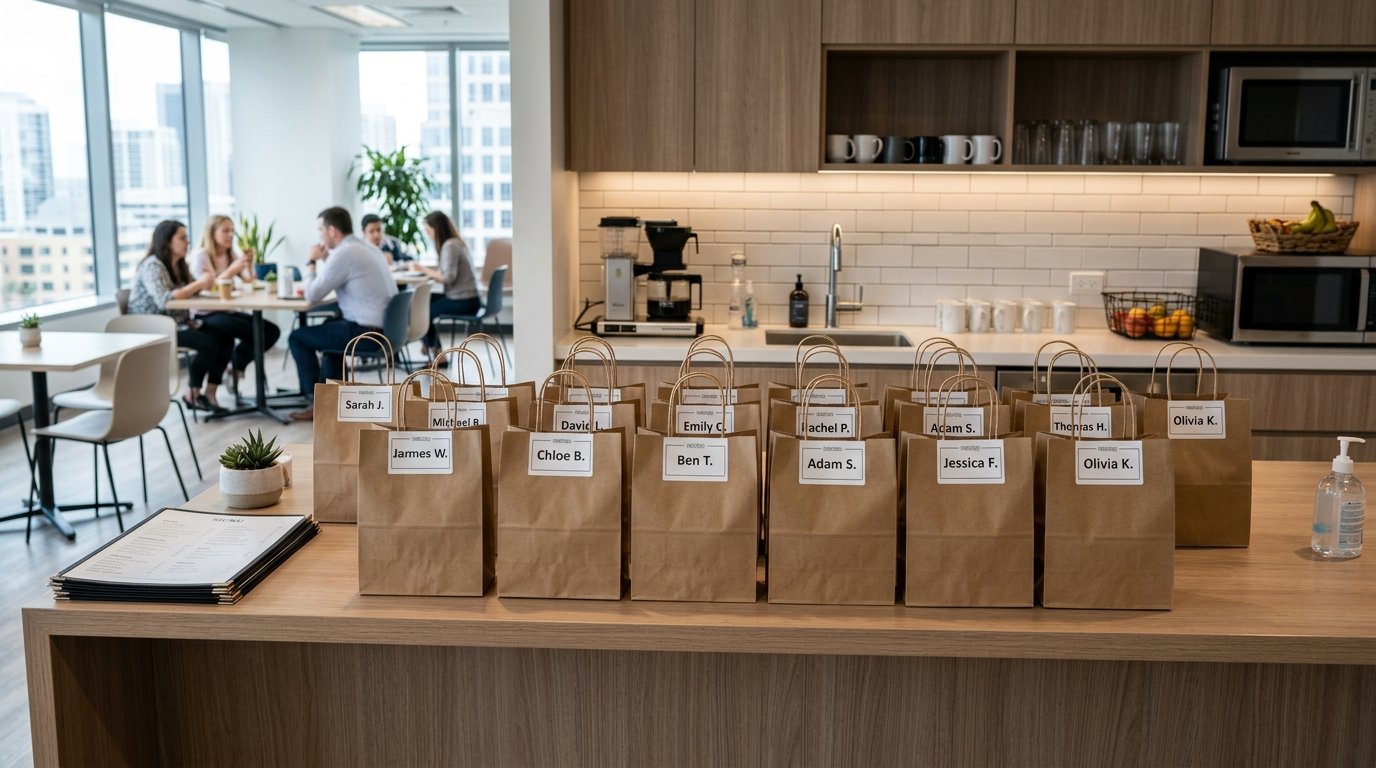
Individually labeled lunch bags lined up at an office breakroom station eliminate reception lobby chaos and misplaced meals.
2. The 2026 Pricing Truth: Markups, Delivery Fees & Employer Costs
Major Menus does not charge employers any setup fees, annual software licenses, or delivery surcharges. For employees, roughly 98% of partner restaurants list items at their exact in-store menu prices. Under platform policies, the remaining 2% of restaurants with razor-thin food costs are permitted a maximum markup of 10% to cover specialized packaging.
Most commercial delivery platforms obscure their actual costs through service fees, delivery fees, regulatory response fees, and inflated menu items. In restaurant industry audits, consumer delivery apps regularly mark up standard menu items by 15% to 30% above in-store counter prices to offset platform commission charges of 25% to 35%.
Here is how Major Menus structures its financial ledger compared to traditional alternatives:
How Does Major Menus Make Money If Delivery Is Free?
A common question from CFOs and office managers is how a platform can deliver meals without charging delivery fees. Major Menus operates on B2B wholesale aggregation logistics:
- Predictable Bulk Production: Instead of taking random single tickets every four minutes during lunch rush, a partner restaurant receives 30 to 75 paid orders simultaneously at 10:00 AM. This allows kitchen prep during slow mid-morning hours.
- Vendor Revenue Share: The restaurant pays Major Menus a negotiated marketing and logistical dispatch commission. Because the restaurant incurs zero marketing costs and sends all meals to a single office address with one courier trip, its delivery costs drop by over 70% compared to third-party courier dispatch.
- Passing Savings to the Office: Because logistics are pooled, the office receives in-store retail pricing without paying individual courier delivery surcharges.
3. The Three Core Services Dissected
Major Menus organizes its platform into three distinct operational products, each designed for different workplace scenarios:
1. Restaurant of the Day
Best For: Routine everyday office lunches.
Rotating local restaurant schedule changes daily. Employees order for themselves and pay with personal credit cards. Zero liability for the employer.
2. Feed My Meeting
Best For: Client lunches, board meetings, trainings.
Catering service available with as little as 2.5 hours notice. Admins can select group menus or distribute spend allowances for attendees to order their own meals.
3. Meal Subsidy Programs
Best For: Employee retention, in-office return incentives.
Employers set automated daily, weekly, or monthly food allowances. Company credit cards cover a designated portion while workers pay any balance above the cap.
4. “Feed My Meeting” Corporate Catering: The 2.5-Hour Lead Time Advantage
Feed My Meeting is Major Menus’ corporate catering arm engineered specifically for last-minute business meetings. While traditional caterers require 24 to 48 hours notice, Feed My Meeting can fulfill group catering orders with as little as 2.5 hours notice, providing office administrators with real-time vendor availability and individual attendee budget controls.
Every executive assistant knows the dreaded morning message: “A client partner just landed at 9:30 AM; we need lunch for 14 executives in Conference Room C by noon.” In most cities, calling standard catering kitchens results in immediate rejections due to prep schedules.
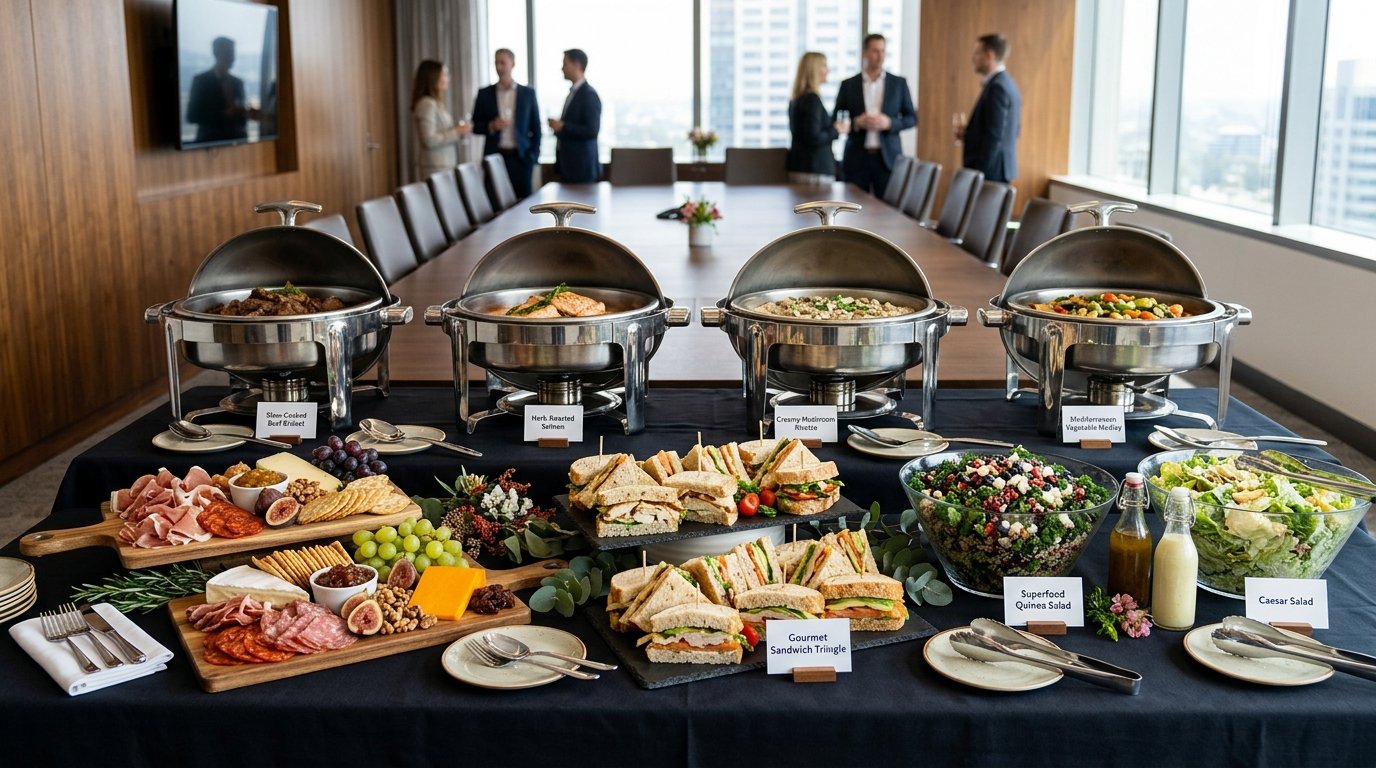
Feed My Meeting handles everything from executive boxed sandwich lunches to hot chafing-dish buffets on short lead times.
Two Ordering Models for Meeting Coordinators
- Model A: Administrator Curated: The office coordinator selects sandwich platters, seasonal pasta salads, boxed wrap combos, desserts, and beverage setups. The order is charged directly to the company corporate account or credit card on file.
- Model B: Attendee Self-Selection with Spending Caps: The coordinator emails an order link with a preset budget cap (for example, $18.00 per person). Attendees select their own preferred meal, accommodations for gluten-free, vegan, or nut allergies are respected, and any overage is either billed to the user or covered under approved company rules.
5. Meal Subsidy & Allowance Plans: The Retention & Productivity Math
Workplace studies from commercial productivity institutes indicate that the average corporate employee spends 11.8 minutes per day browsing delivery apps, deciding on restaurants, and coordinating pickups. An organized meal subsidy program recovers this lost labor time while functioning as a highly perceived employee retention benefit.
In hybrid office environments where companies struggle to encourage staff back into physical workspaces on Tuesdays, Wednesdays, or Thursdays, a company-sponsored lunch perk often proves more motivating than mandatory HR attendance directives.
The Productivity Equation: 25 Employees Over 1 Year
Consider an office with 25 knowledge workers earning an average salary of $72,000/year (~$34.60/hour):
- 12 minutes lost per person per day = 5 hours of collective lost productivity daily across the office.
- Over 3 in-office days per week = 15 hours lost weekly (750 hours annually).
- Financial productivity cost to employer = $25,950 per year in unrecovered time spent scrolling food menus.
By establishing a consolidated single-restaurant ordering routine, employees spend under 90 seconds selecting lunch, recovering hundreds of productive hours annually.
6. Office Lunch Delivery & Subsidy Calculator
Use the interactive tool below to model your company’s weekly lunch budget. Adjust your in-office staff count, number of delivery days, and subsidy percentage to see projected food costs, avoided courier fees, and recovered labor hours:
Office Lunch Delivery & Subsidy Calculator
Compare Major Menus zero-fee pooled delivery against third-party delivery apps (DoorDash/Grubhub) and model custom company meal stipends.
7. Major Menus vs. EZCater vs. DoorDash for Work vs. Grubhub Corporate
Major Menus outperforms competitors in day-to-day office meals because it completely eliminates per-order delivery charges and vendor fragmentation. While EZCater is superior for large national multi-city catering contracts, and DoorDash for Work offers broader fast-food variety, Major Menus provides the cleanest operational footprint for regional offices.
To evaluate whether Major Menus fits your organizational structure, compare the core operating metrics across the four leading B2B lunch delivery models:
8. Geographic Footprint & Supported Markets
Major Menus concentrates its operational footprint across Louisiana metropolitan hubs and Nashville, Tennessee, serving twelve defined municipal territories with dense corporate corridors.
Unlike national platforms that operate purely via algorithms without local dispatch coordination, Major Menus maintains contracted restaurant partner networks and dedicated dispatch routes in specific markets:
Louisiana Metro Hubs
- Baton Rouge (Founding HQ)
- New Orleans
- Metairie
- Lafayette
- Denham Springs
Greater Gulf Suburbs
- Prairieville
- Port Allen
- Addis & Baker
- River Ridge & Jefferson
- Chalmette
Out-of-State & Expansion
- Nashville, Tennessee (Active Hub)
- San Jose, Costa Rica (Pilot Market)
- Upcoming Mobile App (iOS / Android)
Because restaurant participation is curated locally, the rotating daily lineup varies significantly between downtown Baton Rouge, the New Orleans CBD, and suburban office parks in Denham Springs or Metairie. In high-density zones, offices can experience up to 25 different rotating restaurants per month with zero repetition.
9. Logistics, Refunds & Late Deliveries: What Happens When Things Go Wrong?
If an order arrives incorrect or delayed, users report the issue by replying directly to their automated email confirmation receipt or emailing CustomerService@majormenus.com with their order ID. Cancellations can only be refunded if communicated prior to kitchen food preparation.
In food service logistics, mistakes will eventually occur regardless of the platform. Here is how Major Menus handles common operational failure points:
- Missing or Incorrect Items: Because the restaurant prepares all orders together, kitchen assembly errors happen occasionally. Employees reply to their email receipt detailing the discrepancy. In practice, the platform issues an immediate credit to the user’s card rather than dispatching a solo driver for a single missing side item.
- Cancellations: If an employee calls out sick or gets pulled into an offsite meeting after ordering, cancellation eligibility depends strictly on timing. If contacted before the morning cut-off, cancellations are approved with full credit. Once the order reaches the kitchen prep line, refunds cannot be honored.
- Severe Weather & Traffic Delays: In Gulf South metro areas subject to sudden heavy rainfall or bridge congestion (such as the I-10 Mississippi River Bridge in Baton Rouge), delivery windows can occasionally slip by 15 to 25 minutes. Partner restaurants communicate directly with office contact persons to provide updated delivery ETAs.
- Confirmation Failures: If an employee submits an order but never receives an email receipt, the order may not have completed processing. Users should check spam folders immediately, verify their order history under their portal account, or reach out to customer support before 10:00 AM.
Popular Menu Categories & Price Bands Across Partner Restaurants
Meals across Major Menus partner networks fall into four predictable corporate price tiers: Value Express ($9.50 – $12.00), Standard Executive Boxed Lunches ($12.50 – $15.50), Regional Gulf Specialties ($14.00 – $18.50), and Premium Boardroom Entrees ($19.00 – $24.00). Over 85% of office lunch orders concentrate in the $12.00 to $16.00 range.
Because Major Menus rotates local independent dining establishments alongside regional mainstays, the menu selection avoids the monotony of standard corporate fast-casual chains. Here is how core menu categories break down across the network:
Tax Deductions & Corporate Accounting: Navigating IRS Meal Rules
Under current IRS guidelines (IRC Section 274 and Section 119), meals provided to employees on company premises for the convenience of the employer are generally 50% tax-deductible as ordinary business expenses. When food is provided during legitimate business meetings with clients or documented company training sessions, precise record-keeping allows proper corporate write-offs.
When companies set up a Customizable Meal Subsidy Program with Major Menus, the billing reconciliation software streamlines month-end accounting:
- Consolidated Monthly Invoicing: Instead of processing 150 individual employee expense reports with faded paper receipts, accounts payable receives a single, categorized digital statement summarizing food totals, dates, and department tags.
- Exclusion from Employee Taxable Wages: Meals furnished on business premises for genuine employer convenience (for example, keeping staff on-site during tight production cycles or technical shifts) typically qualify under de minimis fringe benefit rules, remaining non-taxable to the employee.
- Audit-Proof Expense Logs: The Major Menus administration dashboard archives complete electronic order logs, timestamped delivery verification, and participant rosters, satisfying corporate compliance standards.
Food Safety, Temperature Retention & Allergen Protocols
Unlike casual third-party delivery gig workers using uninsulated car passenger seats, Major Menus partner restaurants utilize commercial thermal transport carriers designed to maintain hot foods above 140°F (60°C) and cold items below 40°F (4°C) throughout transit, ensuring full HACCP compliance from kitchen assembly to office breakroom.
In large commercial catering operations, thermal degradation is the primary reason office lunches disappoint. When food drops into the “danger zone” (between 40°F and 140°F), textures turn soggy, cheeses separate, and foodborne risks increase. The consolidated delivery model minimizes transit time:
- Short Transit Radii: Partner restaurants are paired geographically with office clusters within a tight 15-to-25 minute drive window.
- Direct Route Dispatch: Couriers do not perform multiple random residential drop-offs. The delivery vehicle travels directly from the commercial kitchen to the client building.
- Allergen Separation: Specialty orders (such as severe peanut allergies or celiac gluten-free meals) are prepared on sanitized kitchen stations and wrapped in distinct packaging with high-visibility warning stickers to prevent contact with standard wheat or nut items.
How Restaurants Join: The Merchant Partner Perspective
For local restaurant owners in Baton Rouge, New Orleans, or Nashville, participating in Major Menus provides a steady corporate revenue stream that differs fundamentally from consumer delivery platforms:
Predictable Kitchen Production
Orders close at 10:00 AM sharp, giving chefs 90 minutes of dedicated prep time before regular walk-in lunch traffic arrives at 11:45 AM.
Single High-Volume Drops
Rather than packaging single sandwich orders for multiple third-party drivers, one staff member delivers 40 to 80 meals to a single office drop point.
Zero Customer Acquisition Cost
Restaurants gain instant access to thousands of corporate workers who frequently return as evening or weekend walk-in guests with their families.
10. Office Manager Implementation Playbook: 6 Rules for a Smooth Rollout
Over twelve years evaluating commercial catering rollouts, the success of any office food program depends heavily on internal communication. Here are six practical practices for workplace coordinators:
- Establish a Designated “Drop Station”: Never let drivers drop food at random front desk counters. Set up a dedicated table in the main employee kitchen or breakroom equipped with hand sanitizer, napkins, and an organized sign reading “Major Menus Lunch Pickup.”
- Schedule a Recurring 9:30 AM Slack/Teams Ping: Because the order cut-off is strictly enforced around 10:00 AM, send an automated bot reminder in your company announcements channel: “Today’s Restaurant of the Day is [Name]. Place your orders by 10:00 AM!”
- Collect Dietary Profiles in Advance: Survey staff to establish what percentage require gluten-free, vegetarian, halal, or dairy-free options. Review your monthly vendor rotation with your Major Menus rep to ensure adequate specialty options.
- Provide Clear Building Access Instructions: Ensure your office profile includes specific delivery driver instructions: loading dock access, freight elevator codes, badge requirements, and front desk telephone extensions.
- Establish the “Grab-Your-Own” Etiquette: Remind staff during the first week that bags are individually labeled by name. Taking the wrong sandwich creates a ripple effect of frustrated coworkers.
- Use Meal Subsidies as Targeted Rewards: Instead of blanket company subsidies, use the platform’s subsidy controls to reward project completion, on-call weekend teams, or quarterly goal achievements.
11. Frequently Asked Questions About Major Menus
What is Major Menus and how does it operate?
Major Menus is a B2B corporate food delivery platform founded in 2007 that connects workplaces with rotating local restaurants. Each office receives a unique Company Access Code. Employees order individually online before a morning cut-off (typically 10:00 AM), and all orders are delivered together in individually labeled bags to a central office location with free delivery and zero employer fees.
Does Major Menus charge setup fees or contracts to employers?
No. There are zero employer setup fees, zero recurring membership dues, and zero binding contracts. The service is entirely optional for workers. Employers merely provide a drop-off table or breakroom counter for courier drop-off.
Are Major Menus food prices marked up compared to restaurant menus?
Approximately 98% of participating restaurants sell food at standard in-store regular menu prices. In rare instances where a restaurant operates on ultra-thin margins, menu items may carry an adjustment capped at a maximum of 10% to cover operational packaging.
What is the Feed My Meeting service on Major Menus?
Feed My Meeting is Major Menus’ corporate catering service designed for board meetings, client presentations, and staff events. It accommodates short-notice catering with as little as 2.5 hours lead time and allows office administrators either to select the entire menu or assign individual attendee budget allowances.
What cities are currently served by Major Menus?
Major Menus operates extensively in Louisiana across Baton Rouge, New Orleans, Metairie, Lafayette, Denham Springs, Chalmette, Baker, Addis, Port Allen, Prairieville, River Ridge, and Jefferson, along with an established market in Nashville, Tennessee.
How does Major Menus compare to EZCater and DoorDash for Work?
Unlike EZCater which focuses primarily on large platters with individual delivery fees ($15-$40+ per drop), or DoorDash for Work which stacks individual platform service fees, Major Menus aggregates individual meals from a single rotating restaurant daily to eliminate delivery fees and prevent reception desk delivery chaos.
12. Final Verdict & Key Takeaways
The Bottom Line on Major Menus
Major Menus occupies a practical sweet spot in corporate workplace dining. By stepping away from the gig-economy model of fragmented courier drop-offs and focusing on batch kitchen coordination, the platform delivers genuine in-store pricing and zero-cost employer logistics. For businesses located in Baton Rouge, New Orleans, Lafayette, and Nashville seeking an organized employee meal perk without budget risk, it remains one of the most efficient workplace dining solutions available.
- Zero financial risk: no setup costs, software charges, or minimum order commitments.
- No delivery surcharges: consolidated daily batches make delivery completely free.
- In-store menu prices: 98% of partner restaurants maintain retail pricing without delivery app markup.
- Fast catering turnaround: Feed My Meeting handles group orders with 2.5 hours notice.
- Hybrid office incentive: meal subsidies offer an effective, measurable magnet for in-office days.
Primary Sources & Research Methodology:
- Major Menus Official Platform Portal & Merchant Partner Documentation (majormenus.com, 2026).
- Donero Industries, Inc. Corporate Registrations and Operating Service Filings (Baton Rouge, Louisiana).
- National Restaurant Association (NRA) Commercial Delivery Surcharge & Third-Party Commission Evaluation Data.
- UC Irvine Workplace Interruptions & Employee Productivity Benchmark Studies (Food app decision latency analysis).